
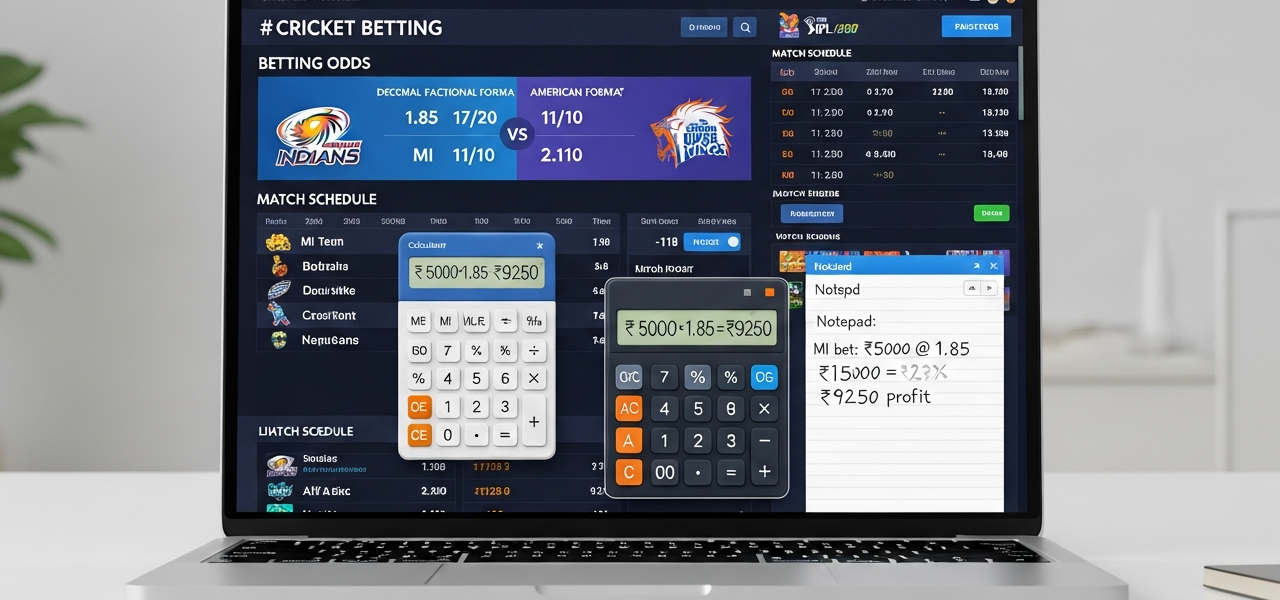
For new Indian bettors, cricket betting odds can appear daunting at first glance. Decimal, fractional, and American formats all present numbers in different ways, making it challenging to understand which bet offers better value or what your potential return might be. This guide demystifies cricket odds step by step, transforming confusing numbers into clear, actionable insights that help you make smarter wagering decisions.
We’ll begin with the fundamentals of what odds actually represent, then progress through each format with rupee-based examples tied to popular Indian markets like the IPL. From there, you’ll learn advanced concepts such as implied probability, bookmaker margin (overround), and value betting—all explained in straightforward language with real-world cricket scenarios. By the end, you’ll be equipped to read any odds format, spot fair prices, and manage your bankroll responsibly.
What Are Cricket Betting Odds And Why They Matter In India
Cricket betting odds are essentially the price you pay for a bet, and they perform two critical functions: they tell you how much you stand to win and they reflect the probability of an outcome occurring. Think of odds as a marketplace price tag—the lower the odds, the more likely bookmakers believe that outcome will happen, and conversely, higher odds indicate an underdog or less probable event.
Consider a hypothetical IPL match between Mumbai Indians and Chennai Super Kings. If Mumbai is quoted at 1.50 and Chennai at 2.80, the odds immediately signal that bookmakers view Mumbai as the favourite. A ₹1,000 stake on Mumbai returns ₹1,500 total (₹500 profit), while the same stake on Chennai yields ₹2,800 total (₹1,800 profit). This simple numerical relationship encodes both risk and reward in every wager.
Understanding odds is not merely about calculating payouts—it’s foundational to responsible betting. Misreading favourite-underdog dynamics can lead bettors to chase losses or overestimate their chances, draining bankrolls quickly. Grasping how odds work ensures you assess each bet’s true risk and make informed decisions rather than emotional ones.
How Odds Link Probability And Payout In Cricket
Every set of cricket odds encodes two pieces of information simultaneously: the bookmaker’s estimate of an event’s likelihood and the financial return you receive if your prediction proves correct. When you see decimal odds of 3.00 on a team, the number implies roughly a 33% chance of victory (calculated as 1 ÷ 3.00), and it also promises to triple your stake if that team wins.
This dual nature makes odds a compact communication tool. Lower odds like 1.20 suggest an 83% implied probability and modest returns, suitable for heavy favourites. Higher odds such as 7.00 indicate just 14% probability but offer substantial payouts to compensate for the increased risk. Recognizing this balance helps you evaluate whether a bet aligns with your own assessment of match conditions, team form, and other variables.
Why Indian Bettors Must Understand Odds Before Betting
Without a solid grasp of odds, even the most passionate cricket fan can fall into common traps: backing short-priced favourites without realizing the marginal profit, or chasing long-shot bets that carry astronomical risk. Responsible betting starts with odds literacy—knowing what 1.80 or 5/2 or +150 actually means in rupee terms and probability terms.
In India’s fast-growing betting market, operators compete fiercely, and odds can vary between platforms. Understanding the numbers empowers you to shop for the best lines, identify value opportunities, and set realistic expectations for your bankroll. It transforms betting from a guessing game into a strategic activity where informed choices drive long-term success.
Cricket Odds Formats Used In India: Decimal, Fractional And American
Indian sportsbooks predominantly display decimal odds because they’re intuitive and instantly show your total return per rupee staked. However, fractional odds remain common in traditional UK-facing books, and American (moneyline) odds appear on global platforms catering to US markets. Familiarity with all three formats ensures you can navigate any site and compare prices effectively.
Decimal odds are the default choice for most Indian apps due to their simplicity: multiply your stake by the decimal to see your total payout. Fractional odds express profit relative to stake, appealing to bettors who like to visualize net winnings at a glance. American odds use positive or negative integers to indicate underdogs and favourites respectively, a system rooted in US sports betting culture.
| Odds Format | How It’s Written | What The Number Means | Quick ₹100 Example | Where You’ll See It |
|---|---|---|---|---|
| Decimal | 2.50 | Total return per ₹1 stake | ₹100 × 2.50 = ₹250 total | Most Indian betting apps, European sites |
| Fractional | 3/2 | Profit per ₹2 stake | ₹100 stake → ₹150 profit + ₹100 = ₹250 | UK bookmakers, traditional exchanges |
| American | +150 | Profit on ₹100 stake (underdog) | ₹100 stake → ₹150 profit + ₹100 = ₹250 | US sportsbooks, offshore platforms |
| American | −200 | Stake needed to win ₹100 (favourite) | ₹200 stake → ₹100 profit + ₹200 = ₹300 | US sportsbooks, offshore platforms |
Each format has its place. Decimal dominates Indian platforms for good reason: new bettors can instantly see total returns without mental arithmetic. Fractional persists in legacy markets and among bettors who prefer to think in terms of profit ratios. American odds, though less intuitive for international users, are standard on major US books and some global aggregators, so understanding them broadens your betting options.
Pros And Cons Of Each Odds Format For Indian Bettors
- Decimal pros: Easiest mental calculation (stake × odds = total), ideal for beginners, directly comparable across markets.
- Decimal cons: Does not instantly show net profit without subtracting stake.
- Fractional pros: Clearly displays profit amount, traditional and familiar in some betting circles.
- Fractional cons: Requires fraction arithmetic, less intuitive when comparing multiple odds quickly.
- American pros: Clearly separates favourites (negative) from underdogs (positive), useful for moneyline-heavy sports.
- American cons: Two different formulas (positive vs negative), confusing for those unfamiliar with US conventions.
How To Read Decimal Cricket Odds In Rupees
Decimal odds represent the total amount you receive for every rupee you wager, including your original stake. The formula is straightforward: Total Return = Stake × Decimal Odds. If you place ₹500 on a team at 1.85, your total return is ₹500 × 1.85 = ₹925, meaning a net profit of ₹425.
This format shines when comparing multiple betting options side by side. Suppose three IPL teams have odds of 2.10, 3.50, and 5.00 for the tournament winner. A quick glance tells you the first is the bookmaker’s favourite, the third is the long shot, and the middle option offers balanced risk-reward. Decimal odds eliminate guesswork and make value hunting efficient.
Because decimal odds include your stake in the payout figure, they are ideal for calculating potential profit across different stake sizes. Whether you’re betting ₹100 or ₹10,000, multiplying by the decimal gives an instant picture of your total return, simplifying bankroll planning and record-keeping.
Basic Decimal Odds Formula And Worked Examples
| Decimal Odds | Stake (₹) | Total Return (₹) | Net Profit (₹) | Comment |
|---|---|---|---|---|
| 1.50 | 1,000 | 1,500 | 500 | Heavy favourite, modest profit |
| 2.20 | 500 | 1,100 | 600 | Moderate favourite, balanced return |
| 3.75 | 200 | 750 | 550 | Underdog, higher profit potential |
| 6.00 | 100 | 600 | 500 | Long shot, substantial upside if correct |
| 1.10 | 5,000 | 5,500 | 500 | Overwhelming favourite, minimal profit |
The table above demonstrates how stake size and odds combine to determine outcomes. Notice that even high favourites like 1.10 require large stakes to yield meaningful profit, while underdogs around 6.00 can deliver significant returns on smaller wagers. This trade-off between risk and reward is central to cricket betting strategy.
Using Decimal Odds To Compare Favourites And Underdogs
Imagine an IPL clash where Rajasthan Royals are priced at 1.65 and Kolkata Knight Riders at 2.35. The lower number instantly flags Rajasthan as the favourite—bookmakers assign them roughly a 60% chance of winning. Kolkata’s higher odds reflect a perceived 43% probability, positioning them as the underdog but still competitive.
For bettors, these odds guide both selection and stake sizing. Backing Rajasthan offers safer returns but requires a larger stake to achieve a target profit. Kolkata presents higher variance: riskier, yet potentially more rewarding. By reading decimal odds fluently, you can tailor your bets to your risk appetite and analytical edge, rather than betting blindly on team loyalty.
How To Read Fractional Cricket Odds
Fractional odds display the profit you earn relative to your stake, written as a ratio such as 5/1 (read “five to one”) or 11/4 (“eleven to four”). The first number represents potential profit, the second your stake. If you bet ₹100 at 5/1 and win, you receive ₹500 profit plus your ₹100 stake back, totaling ₹600.
This format has deep roots in traditional UK bookmaking and horse racing. Many seasoned bettors prefer fractional odds because they emphasize net winnings at a glance, making it easy to assess whether a wager justifies the risk. While less common on Indian apps, fractional odds still appear on international exchanges and legacy platforms, so fluency pays dividends when shopping across borders.
Calculating total payout from fractional odds requires adding your stake to the profit. For 11/4 odds with a ₹200 stake, you compute profit as (11 ÷ 4) × 200 = ₹550, then add the ₹200 stake for a total return of ₹750. Though slightly more involved than decimal multiplication, the format remains intuitive once you practice a few examples.
Fractional Odds To Rupee Payout Examples
| Fractional Odds | Meaning | Stake (₹) | Profit (₹) | Total Return (₹) |
|---|---|---|---|---|
| 5/1 | Win ₹5 per ₹1 staked | 100 | 500 | 600 |
| 11/4 | Win ₹11 per ₹4 staked | 200 | 550 | 750 |
| 1/2 | Win ₹1 per ₹2 staked | 500 | 250 | 750 |
| 9/2 | Win ₹9 per ₹2 staked | 300 | 1,350 | 1,650 |
How To Read American (Moneyline) Odds In Cricket
American odds use positive and negative integers to communicate favourites and underdogs. Positive odds (e.g., +200) indicate how much profit you earn on a ₹100 stake; negative odds (e.g., −150) show how much you must stake to win ₹100 profit. Though rooted in US sports culture, these odds appear on global sportsbooks and offshore platforms accessible to Indian bettors.
For example, if India is listed at −180 to beat Bangladesh, you need to wager ₹180 to profit ₹100 (total return ₹280). Conversely, if Bangladesh sits at +250, a ₹100 bet yields ₹250 profit (total ₹350) if they pull off the upset. The sign immediately tells you which side the bookmaker favours, with the magnitude reflecting the degree of advantage.
While less intuitive than decimal for quick mental math, American odds are standard on major platforms like DraftKings and FanDuel. Understanding them expands your betting options and allows seamless navigation of international markets, especially when live-betting high-profile tournaments streamed in multiple regions.
Positive Vs Negative Moneyline Odds With INR Examples
| Moneyline Odds | Type | Stake (₹) | Profit Formula | Example Profit (₹) | Total Return (₹) |
|---|---|---|---|---|---|
| +200 | Underdog | 100 | Stake × (Odds ÷ 100) | 200 | 300 |
| −150 | Favourite | 150 | Stake × (100 ÷ |Odds|) | 100 | 250 |
| +350 | Underdog | 200 | Stake × (Odds ÷ 100) | 700 | 900 |
| −220 | Favourite | 220 | Stake × (100 ÷ |Odds|) | 100 | 320 |
Converting American Odds To Decimal For Easier Comparison
- For positive odds: Divide the moneyline number by 100, then add 1. Example: +200 becomes (200 ÷ 100) + 1 = 3.00 decimal.
- For negative odds: Divide 100 by the absolute value of the odds, then add 1. Example: −150 becomes (100 ÷ 150) + 1 ≈ 1.67 decimal.
- Use the decimal result to compare directly with other markets or quickly calculate total returns by multiplying your stake.
Converting Cricket Odds Into Implied Probability
Implied probability translates odds into a percentage that represents the bookmaker’s estimate of an outcome occurring. This conversion reveals how confident the market is in each result and helps you assess whether the odds offer value relative to your own analysis. The formula for decimal odds is simple: Implied Probability (%) = (1 ÷ Decimal Odds) × 100.
For instance, decimal odds of 2.00 yield an implied probability of 50%, while 3.50 equates to approximately 28.6%. By comparing these percentages to your own probability estimates—based on team form, pitch conditions, player injuries, and historical data—you can identify discrepancies that signal profitable betting opportunities.
| Odds Format | Example Odds | Formula | Implied Probability | What It Suggests In A Match |
|---|---|---|---|---|
| Decimal | 1.80 | (1 ÷ 1.80) × 100 | 55.6% | Strong favourite, moderate confidence |
| Decimal | 3.20 | (1 ÷ 3.20) × 100 | 31.3% | Underdog, plausible chance |
| Fractional | 5/2 | (2 ÷ 7) × 100 | 28.6% | Outsider with decent payout |
| American | −200 | (200 ÷ 300) × 100 | 66.7% | Heavy favourite, bookmaker expects win |
| American | +150 | (100 ÷ 250) × 100 | 40.0% | Competitive underdog, realistic upset |
Using Implied Probability To Judge If Odds Look Fair
Once you’ve converted odds to implied probability, compare it against your own assessment. Suppose you believe India has a 65% chance to defeat Pakistan in a T20, but the bookmaker offers odds implying only 58%. That gap represents value: you perceive a higher likelihood than the market does, making the bet mathematically favorable in the long run.
This principle underpins value betting. Consistently finding situations where your probability estimate exceeds the bookmaker’s implied probability leads to positive expected value (EV), the cornerstone of profitable sports betting. It requires disciplined analysis and honest self-assessment, but mastering implied probability transforms betting from guesswork into strategy.
Bookmaker Margin (Overround) In Cricket Odds
Bookmaker margin, also known as overround or vig, is the built-in profit edge that ensures sportsbooks stay profitable regardless of the outcome. When you convert all possible outcomes of a market into implied probabilities and sum them, the total exceeds 100%—that surplus is the bookmaker’s margin. For example, if Team A is 1.90 (52.6%) and Team B is 2.00 (50%), the total is 102.6%, meaning a 2.6% overround.
This margin represents the “price” you pay to access the betting market. Lower margins mean fairer odds and better value for bettors; higher margins tilt the playing field further in the bookmaker’s favor. Understanding overround helps you evaluate which platforms offer competitive pricing and where you’re overpaying for the same wager.
Consider an India versus Australia ODI where one bookmaker quotes India at 1.85 and Australia at 2.10 (total implied probability ~102%), while another lists India at 1.80 and Australia at 2.05 (total ~105%). The first book has a tighter margin, offering better long-term value even if the difference per bet seems small—over hundreds of wagers, those percentage points compound significantly.
Quick Method To Check If A Cricket Market Is Tight Or Expensive
- Convert each outcome’s odds to implied probability using the formula (1 ÷ decimal odds) × 100.
- Sum all implied probabilities for every possible result in the market (e.g., Team A win + Team B win for a two-way market).
- Subtract 100 from the total to find the bookmaker margin. A sum of 103% means a 3% margin; 108% signals an 8% margin and less favorable odds.
Why Comparing Odds Across Indian Bookies Reduces Margin Impact
Line shopping—the practice of checking multiple sportsbooks before placing a bet—directly counters the margin disadvantage. If Bookie A offers Mumbai Indians at 1.75 and Bookie B lists them at 1.82, choosing Bookie B increases your potential return by 4% on that single wager. Multiply this discipline across dozens of bets, and you effectively reclaim a portion of the overround that would otherwise erode your bankroll.
In India’s competitive online betting landscape, platforms frequently adjust odds to attract volume or balance their books. Savvy bettors maintain accounts on several licensed or reputable sites, comparing lines before committing funds. This habit not only maximizes value but also provides access to promotions, bonuses, and diverse market offerings that enhance overall betting experience.
Common Cricket Betting Markets And How Odds Apply
Cricket betting extends far beyond simple match-winner wagers. Modern sportsbooks offer dozens of markets per game, each with distinct odds that reflect varying levels of risk and predictability. Understanding how odds apply across these markets empowers you to diversify your strategy and find niches where your analytical edge is strongest.
- Match Winner: The most straightforward market; odds directly correlate with perceived team strength and recent form.
- Top Batsman/Bowler: Player prop markets carry higher variance because individual performances fluctuate; odds are typically longer and offer bigger payouts.
- Total Runs Over/Under: Odds reflect expected run totals based on pitch conditions, weather, and batting lineups; sharp bettors exploit overreactions to recent high or low scores.
- First Innings Runs: Similar to totals but isolated to one team; useful when you have strong insights into a specific batting order or bowling attack.
- Method of Dismissal: Niche markets like “next wicket caught” or “bowled” offer very high odds due to randomness, suited for small-stake entertainment bets rather than serious bankroll allocation.
- Session Betting (Test Cricket): Wagering on runs scored in a specific session; odds shift throughout the day as conditions and momentum change.
Format‑Specific Odds: Test, ODI And T20 In India
Each cricket format introduces unique dynamics that influence how bookmakers set and adjust odds. Test matches span five days with the possibility of draws, so three-way markets (Team A / Team B / Draw) distribute probability across more outcomes, often resulting in higher individual odds. The draw option typically sits between 3.00 and 5.00 depending on pitch reputation and weather forecasts.
ODI cricket condenses action into 50 overs per side, reducing draw likelihood to weather interruptions handled by Duckworth-Lewis-Stern. Odds are generally tighter than Tests, with favourites often below 2.00 and underdogs ranging 2.50–4.00. T20 leagues like the IPL bring extreme volatility: momentum swings are frequent, batting collapses common, and live odds can fluctuate wildly within minutes. Pre-match favourites may drift to 3.00+ after losing early wickets, creating in-play value opportunities for alert bettors.
Pre‑Match Vs Live Cricket Odds: How They Move And Why
Pre-match odds are set days or hours before the first ball, incorporating all available information—team news, historical head-to-heads, pitch reports, and public betting patterns. These odds offer stability and time for thorough analysis, ideal for bettors who prefer research-driven decisions without the pressure of real-time events.
Live (in-play) odds update continuously as the match unfolds, reacting to every wicket, boundary, partnership, and strategic shift. A team priced at 1.60 pre-match might balloon to 4.50 after losing three quick wickets, then crash back to 2.00 if a partnership stabilizes the innings. This volatility creates both risk and opportunity: disciplined live bettors capitalize on overreactions, while impulsive punters chase losses and magnify variance.
| Aspect | Pre‑Match Odds | Live (In‑Play) Odds | What It Means For Bettors |
|---|---|---|---|
| Information | Based on stats, news, public money | Real-time match events, momentum | Live odds reflect current state, pre-match relies on projections |
| Stability | Changes slowly, minor line moves | Volatile, updates every ball or over | Pre-match suits research; live demands quick decisions |
| Value Opportunities | Found through deep analysis, model edges | Market overreactions to wickets, runs | Both offer value; live requires watching match closely |
| Typical Use | Strategic bets, long-term bankroll plans | Reactive bets, hedging, cash-out options | Mix both for diversified betting approach |
Key Factors That Shift Live Cricket Odds In India
- Wickets: Each dismissal dramatically alters match dynamics, especially early collapses or loss of set batsmen; odds swing instantly.
- Partnerships: A 50-run stand can stabilize a shaky innings, causing favourites’ odds to shorten and underdogs’ to lengthen.
- Rain Interruptions: DLS recalculations change target scores, introducing uncertainty that widens spreads and shifts probabilities.
- Powerplay Performance: Explosive starts or tight bowling in the first six overs set the tone, prompting rapid odds adjustments.
- Toss Result: In formats where pitch conditions heavily favor batting or bowling first, the toss outcome can move pre-match odds by 10–20%.
Practical Example Of Odds Movement In An IPL Match
Imagine Chennai Super Kings batting first against Punjab Kings. Pre-match, CSK are 1.70 favourites. After winning the toss and electing to bat, their odds tighten to 1.60 as the pitch report suggests a batting paradise. In the powerplay, CSK lose two early wickets and manage only 35 runs; live odds drift to 2.10 as the market anticipates a below-par total.
However, a Ravindra Jadeja–MS Dhoni partnership adds 80 runs in ten overs, steadying the innings. CSK’s odds contract back to 1.75. They post 185, a competitive score. During Punjab’s chase, an explosive start by their openers sees CSK drift again to 2.50. Then Punjab lose three wickets in four balls to Deepak Chahar; CSK’s odds crash to 1.40, reflecting renewed control. This roller coaster illustrates how live odds mirror the ebb and flow of T20 cricket, rewarding bettors who read momentum shifts accurately.
Using Odds For Value Betting, Bankroll Management And Safer Play
Value betting is the practice of identifying wagers where the true probability of an outcome exceeds the bookmaker’s implied probability. Over time, consistently betting on positive expected value (EV) propositions generates profit, even if individual bets lose. The key is disciplined analysis: estimate probabilities honestly, compare them to market odds, and stake only when you hold an edge.
Bankroll management complements value betting by controlling risk. Even the sharpest bettor experiences losing streaks due to variance; proper staking ensures you survive downswings without going bust. Common strategies include flat betting (fixed percentage per wager), the Kelly Criterion (stake proportional to edge), and unit systems that scale bets to confidence level. Combine these with odds literacy, and you build a sustainable, safer betting practice.
- Estimate True Probability: Use stats, form, conditions, and your cricket knowledge to assign a percentage chance to each outcome.
- Convert Bookmaker Odds: Calculate the implied probability from the odds offered on your chosen market.
- Compare Probabilities: If your estimate is higher than implied probability, you’ve found value; if lower, skip the bet.
- Determine Stake Size: Allocate a percentage of your bankroll (e.g., 1–3% per bet) based on your edge and confidence.
- Track Results: Maintain a betting log to review performance, refine probability estimates, and adjust strategies over time.
Step‑By‑Step Example Of A Value Bet In A Cricket Match
You’re analyzing an IPL game: Sunrisers Hyderabad versus Delhi Capitals. Bookmaker odds on Sunrisers are 2.40, implying a 41.7% win probability. After reviewing recent form, key player availability, pitch history, and head-to-head records, you estimate Sunrisers have a 50% chance to win. The gap (50% true vs 41.7% implied) represents an 8.3% edge.
To calculate expected value, use the formula: EV = (Probability of Win × Profit) − (Probability of Loss × Stake). On a ₹1,000 bet at 2.40 odds, profit if you win is ₹1,400. EV = (0.50 × 1,400) − (0.50 × 1,000) = 700 − 500 = ₹200 positive EV per ₹1,000 wagered. Over many such bets, this edge compounds into long-term profit, demonstrating how understanding odds transforms cricket betting into a skill-based endeavor rather than pure chance.